Greetings everyone,

Biobunch.
Over and out.
Not sure how you guys are feeling about this years shark week, but if we didn't make ourselves clear on the previous post about the Megaladon then let us just say that we are officially OUTRAGED!! We would like it to be noted that Discovery Channel and NatGeoWild have shamed the annual marvel that is shark week. Firstly, shark week is about raising awareness about sharks, creating a deeper understanding about this often misunderstood and misrepresented creature of the deep, informing the public that sharks are not hell bent determined on killing every single human being that ever enters the ocean. Secondly, why is it that every single documentary that is shown shows the sharks behaviour and then leaves it at that, why are they not going into the anatomy of the sharks the biology that drives these amazing animals to do what they do. Instead what we get is the following: When Sharks Attack, followed by When Sharks Attack and ended with When Sharks Attack. Moral to the story viewers, sharks are evil! Well that's the vibe we feel when we watch these documentaries tell us after watching these do you come away with an overpowering urge to HELP SAVE THE SHARKS?! No, well we don't blame you!.
This lead us to the post we are giving you today, a true dedication to why sharks are awesome! in the next two posts we will mind blow you with some awesome shark biology. Enjoy!
The Lateral Line System:
Ever wondered how sharks are able to pinpoint their prey with deadly accuracy, or how they are able to navigate there way across half the globe, well the simple answer would be their lateral line system. This system is made up of tactile sense organs that are able to detect movement and pressure changes in the surrounding water, in a few words it is able to detect water displacement.
 |
| The lateral line system is visible to the naked eye on sharks. They are seen as small skin perforations on the sharks cavity. |
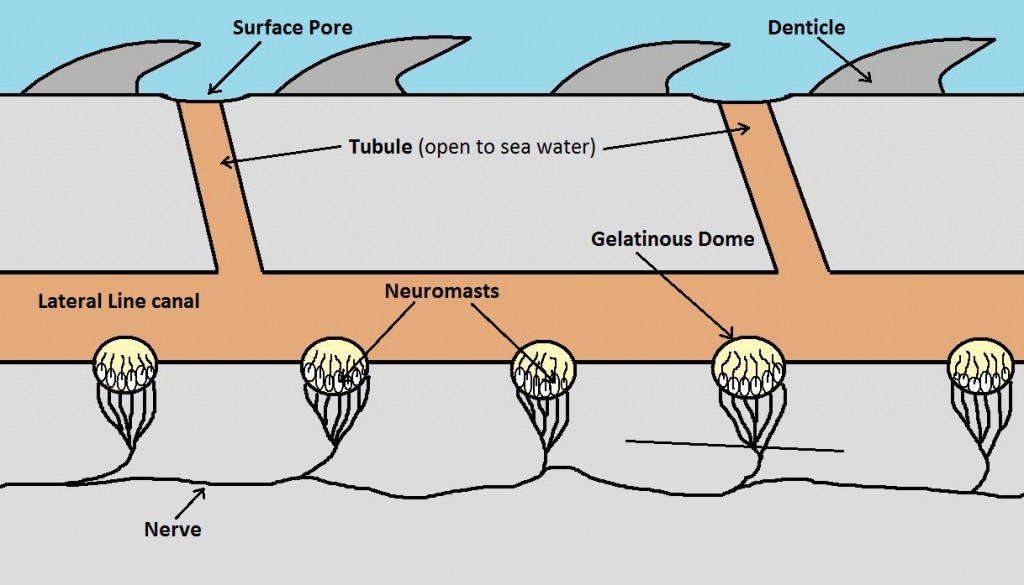
Each perforation seen on the shark contains a bunch of mechanorecptors (receptors that receive mechanical stimuli) also known as neuromasts. They lie embedded in mucus filled canals called the lateral line canal, the neuromasts are made up of sensory cells and support cell and as seen in the picture below they are encapsulated within a gelatinous dome, the tubule given the neuromasts direct contact with external stimuli. But how do they use this for prey detection? Well picture this, a seal is swimming thereby displacing the water surrounding it, these waves sweep across the sharks surface and the change in pressure is carried down the tubule and into the lateral line canal. This pressure change causes the gelatinous dome to bend, causing the neuromasts to bend also- thereby triggering an electrical change in the basal body (the individual cells in the neuromasts) the neurotransmitters pick this change up and the sensory nerve carries this to the brain where it is interpreted and the shark can either choose to move towards it or ignore it.
It doesn't stop there...:
Some of the neuromasts made up of mechansosensory receptors have become evolutionary modified to become electrorecpetors, this specialised system concentrated mainly around the snout of the shark is called the Ampullae of Lorenzini. With this the shark has enhanced its ability in detecting indirect touch, as they are now able to detect minute electrical potentials which are generated by muscular contractions. When humans swim for instance they give of a different electrical field compared to that of the surrounding water, which is then carried to the ampullae of lorenzini. It also explains how sharks are able to migrate their way across such large distances, because they are able to detect the earths electromagnetic field.
 |
| A diagram showing the structure of this system. Similar to that of the lateral line system, but is connected straight to the external environment. |
 |
| Similar to that of the lateral line system you are able to see the perforations with your naked eye! |
Well that rounds up today's post on how the Great White Shark uses two of its most interesting sense for prey detection!! For those of you who are craving more information on shark anatomy and can not wait for our awesome post tomorrow have no fear because below you will find the full documentary of INSIDE NATURES GIANTS: THE GREAT WHITE SHARK! now this is what we call shark week material! Tomorrow we shall be answering some pretty awesome questions on the physiology. Make sure you don't miss out on it!!
Biobunch.
Over and out.