Greetings everyone,
We would like to kick of this post today by apologizing on the lack of new articles put on our blog since the poor excuse that was shark week, but let us assure you that it will be back to the usual from this point on!! We would like to thank all the people that have continued to keep looking at our blog we are truly appreciative. Lets talk about bees...
Bees are declining at
an unprecedented rate and they are declining faster in Britain than in the rest
of Europe, which is surprising because if the last 800 years is anything to go
on we were known as the Isle of Honey! We are not the only one in this boat America
has lost some 4 million honeybee colonies in 2008; France lost 500,000 in 1997
with Brazil, Canada, Europe, India, Argentina and China reporting a declining
number.
More than 250 species of bee are threatened with extinction and sadly 3 of them have already gone extinct. Now for some buzzing facts, Britain is home to 25 different species of
bumblebee, which are further subdivided into 2 different families:
Bombus: Characterized by living in small colonies.
Psithyrus or Cuckoobees: these bees lay eggs in the nests of other bees for them to raise! Cheeky.
Of all the bees in Britain there are only 3 different types:
Bumblebees:
Honey bees:
Solitary bees:
never heard of this
type of bee before well neither had we it turns out that they make up most of
the worlds bees and they live alone in holes or in burrows. They store the
honey made and the sweet little things have no sting! And Britain proudly has
more than 200 species of this bee.
"Bees are the canary in
the coal mine- so intrinsically interconnected with our ecosystem that their
disappearance is a warning signal. Protect them and we protect our future."
UN Environment Programme.
Losing the worlds
most precious pollinators would be a devastating loss to our environment, without
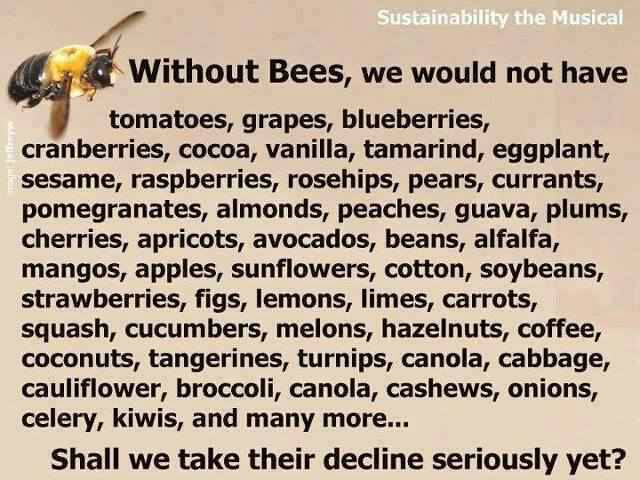
them we would have no honey, no chocolate (I mean ladies come on!), no silk, almost no fruit, less
cotton, less meat, less dairy, fewer species, fewer vegetables and fewer wild
flowers. Try and picture the world if we had no bees, we tried and all we could
picture was an arable desert imagine going to Kew gardens to see the flowers
only to get there and see empty plots! Umm money back please!!
But why? Why are our
bees disappearing and what can we do??
It’s funny how
governments make it seem so intricate and such a huge mystery as to why our
bees are declining at such a fast rate, well let us just say it actually isn’t.
Pesticides. Habitat Loss. Less Food. Changes in land use. Bee keeping
methods. Ta-dah that’s it.
The thing about
pesticides is that they are not specific to one insect and we often forget this fact. When they are laid down they will kill or damage all living organisms that eat
it… including us. Ever wondered how these work, well they are nasty things they
literally attack the nervous system of the insect and they do the very same
things to us if we digest them. Exposure for humans has been linked to the
following, Parkinsons disease, infertility and a whole cocktail of other
diseases. That’s why more of us should buy organic products, they are GMO (genetically modified crops) banned and pesticides are avoided at all costs. Organic farms focus on natural eco-systems and native species ensuring that there are wild species on the margins of fields and hedgerows thereby protecting the diversity of the surrounding environment.
But can Britain go
completely pestcide free, I mean has anyone else done it?
YES. Due to the mounting
evidence against pestcides and their effects on human health Paris and Tokyo
are now pesticide free and now there urban native bee population is
thriving. In fact the populations of urban bees are doing better than their
rural counterparts (but we will talk about why later).
The British government
policy is not able to ban something like pesticides without conclusive evidence
and even when there is very convincing evidence they don’t make any promises.
Surely the evidence must be valid and very conclusive for two different cities to go completely pesticide free?? Funnily enough the British
government are working of the results from experiments conducted by the
pesticide manufacturers themselves… yeah because those results cant be biased right...
Neonicotinoids…
Thought to be at the
very heart of why the worlds bees are disappearing… apart from Paris and Tokyo
of course.
Cast your mind back to
the DDT dilemma. It was
banned due to its adverse effect on our health it caused liver damage, liver
cancer, nervous system damage, birth defects and other reproductive harm. So
yeah not that great. Well get a load of this…
Neonicotinoids are
7,000 times more toxic than DDT, which was banned in Britain in 1984.
These harmful
pesticides penetrate the plant and attack the nervous system of the insects
that sadly feed on them. France banned neonics in 2000 after several extensive
studies showed that even a small dose causes disorientation and impaired
foraging ability. Italy, Germany and Slovenia followed suit banning the sales
of two neonics manufactured by Bayer.
A leaked memo sourced
from the US Environment Protection Agency had warned that bees and other
pollinators including our native butterflies are all at risk from the neonics
ending up in the pollen and nectar of flowers, this then washes into streams the
rivers and the ponds which then destroy our aquatic life and stays in the soil
for many years. So environmental disaster.
Loss of habitat:
Since the Second World War Britain has lost 3 million hectares of wild flowers now only 100,000
hectares remain and these diminish each minute. The loss of habitat and food is
mainly down to the expansion of agricultural farms and the fashion in gardens
for ornamental flowers and perfect lawns. The intimate story of the bees and our
habitat is a classical symbiotic relationship, in that with no bees you have no
floral habitat, and with no floral habitat you have no bees. The Change of land
use to a mono crop field equals bad foraging, by providing little and sometimes
no food.
But YOU can help, it
has been shown that bumblebees, honeybees and solitary bees all benefit from
our own back yards a lot more than the countryside. It could be as small as a
window box, or as big as your whole garden, if you could even spare a small
portion of your garden you could happily now that you are offering bees a
sanctuary and thereby ensuring yours and your families future. It is really as
small and as simple as that.
.JPG) |
| It does not have to be as large as the garden above which is located at Dunster Castle but it is lovely to see a garden coming alive with buzzing bees literally. My family and I visited and loved it! |
.JPG) |
| After a massive decline in honeybee numbers after a CCD outbreak bumblebees and other pollinators picked up the slack and practically did 100% of the work. (taken by my dad and I) |
In fact take a look at this picture for ideas on some bee friendly plants! having trouble seeing it please visit friends of the earth who include this in there bee saving kit.
All that our wild bees
require from us is...
1. A place where there
are flowers blooming all year round.
2. Those of you with gardens a bit of bare ground for those lovely solitary bees
mentioned earlier to call home.
3. And of course protection from chemical attacks. (pesticides, herbicides
fungicides any un-natural chemical really) those of you growing veggies or fruit
these flowers will attract wasps which are known aphid killers, also known as biological control!
Beekeeping:
Just when you think
that beekeepers care about bees they just go and betray our trust. Well it
turns out that even some bee keepers become profit driven and as such the bees
welfare loses out. An increase in honey production and increased use and access
to pesticides and other toxic chemicals has lead to stressed bees which then
increases the colonies susceptibility to diseases such as CCD ( colony collapse
disorder).
Many beekeepers follow
what is called ‘commercial’ practices which in turn lead to widespread
acceptance of beekeeping methods which are no where near to being considered as
bee friendly. In response to this mistreatment and increasing awareness from
the public the Natural Beekeeping Alliance is now heading a movement
encouraging a more holistic approach- in other words more consideration towards
the bee and less profit driven.

For happy bees natural
beekeeping is definitely the best way. Really this method relies on the
foundation of minimum interference- avoiding the opening of the beehives too
often, NOT clipping the queens wings to prevent swarming, avoiding the use of
synthetic chemicals and medications and finally adapting a ‘supervisory’ rather
than a ‘managerial’ attitude. Main take home message is that natural beekeepers
take care of the bees and take all other natural pollinators into account, yep
that includes your butterflies, moths, wasps and other creepy crawlies. Guess
what to all of our lovely readers YOU CAN BECOME A NATURAL BEEKEEPER! For more
details visit Barefoot Beekeeper.
Bees need our help,
they need your help, they need the worlds help and we can do it. We aren’t sure
at what point our British government is actually going to realise this rather
urgent matter! Maybe they eat food that isn’t pollinated by bees at all which
is strange because both bees and wild pollinators pollinate 84% of EU crops. Or
maybe they are not bothered at losing our pollinators which would cost our
economy £1.8 billion a year and of course trigger an environmental apocalypse
and see a massive decline in our animals and birds.
“Not a single bee has
ever sent you an invoice. And that is part of the problem-because most of what
comes to us from nature is free… we tend to ignore it” Pavan Sukhdev, author of
the UN report the economics of ecosystems and biodiversity.
Scary to think that
honeybees are thought to go extinct in Britain in 2018. We have told you that
you can help by planting bee friendly plants in your garden, try and buy
organic food, don’t use chemical methods in your gardens try biological
controls (remember the wasp!). And most importantly sign the petition to ban neonicotinoids visit this website to see more details! There are so many companies fighting for the bees and we have helped
you get started with a few links below! Good luck!!
Biobunch.
Over and out.


.JPG)
.JPG)
.JPG)