Showing posts with label Featured. Show all posts
Seasons Greetings everybody!!!

It’s the most wonderful time of the year! Why? Because it's beginning to feel a lot like Christmas. Okay I will stop now haha however I could go on for a very very long time with this.

Planet Earth has now officially finished, which I am devastated about but all things must come to an end. David Attenborough as well as his truly dedicated research team managed to transport us straight to some of the most dramatic events Nature offers against breathtaking backgrounds, so a huge THANKS to the team that brought us close to Planet Earth again. Hopefully we will see it again in another four years!

On today’s post I have taken inspiration on an element from the Planet Earth series. Animal fights. This calls to mind the colossal fight between the two giant dragons from the Islands episode and so many more - but we are looking into something in particular… what makes a champion in the animal world? How do individuals win fights? As in all things within nature it is not a clear cut answer, however there are several factors that greatly influence the winner once a fight starts.

Size matters:

The scene was set. We were taken to an island were the biggest predator was the largest lizard on the planet. The great Komodo Dragon. What triggered the fight? Mating rights. Two rivaling males battling it out for access to female in heat. Before entering a fight and risking injury or death the two males assess each other's fighting potential using body size as an indicator. However, when both are equally matched a contest is inevitable.

Image Source

In Asian elephants physical size was found to be a significant factor on the success of the fighting outcome. Those that were physically bigger are more likely to win contests.

Greetings everybody, 

It's Monday which means it's not everybody's favourite day of the week but I read something recently that said reading a scientific blog post on a Monday increases individual productivity by up to 30%! 

Am I lying about that figure... yes, yes I am. Let's get to the point though shall we, today we are looking on the stranger side of nature, today we learn about how a parasite can manipulate the mind of its host. 

Introducing Toxoplasma Gondii

Image Source


This single-celled intracellular protozoan has the capability of infecting all mammals and even birds and leads to the onset of toxoplasmosis. The disease caused by this pathogen, Toxoplasmosis, is of serious medical, veterinary and economic importance. The Centre for Disease Control recognises Toxoplasma Gondii and the disease it causes to be a Neglected Parasite Infection and as such is targeted by the  CDC for public health action. 

Parasitic lifestyles are always a bit complicated... 

Image Source

Gametes (the sex cells) of the parasite meet on the inside of a predator (usually a cat) gut and fuse together to form an oocyte. 
The oocytes that carry the infectious agents are shed in the cat's faeces. Changing of the cat litter and failing to wash hands could lead to humans ingesting the parasite themselves, and in pregnant women could lead to vertical transmission from mother to baby. Alternatively, the oocytes could work their way up the food chain and contaminated drink or undercooked meat could lead to people getting infected also. 

The "Fatal Attraction Phenomenon"

The most interesting route of transmission, however, comes when a mice becomes infected with the oocyte itself. The effects of the parasite on mice are unique in that this pathogen invades the brain of the mice and removes the fear of cats. This manipulation can partly be explained by the manipulation hypothesis. It states that parasites altering the behaviour of its host for the continued existence of the parasite, often by intensifying its chances for successful transmission.  

If you're still wondering why this parasite removes the inbuilt fear of cats in mice allow me to explain further. Toxoplasma gondii is able to infect a wide range of mammals and birds. However, cats are the only mammals known to shed the parasites oocytes in their faeces, as their gut offers the perfect environment to complete their life cycle, making cats the ultimate endgame. 

Interestingly, rodents are not only absent of all fear to cats but have been shown to be drawn towards the smell of a cat's urine! How does this "fatal attraction phenomenon" work? Toxoplasma gondii may have an anxiolytic effect on rodents infected by it. It has been shown in past studies that by blocking key receptors that are usually anxiogenic it allowed rats to feel a sense of reduced anxiety in situations where predator threat was high.  This increases the chances of the parasite landing exactly where it wants to be, in the gut of a cat, by causing the mouse to be eaten! 

Are you a man, a mouse, or a mouse infected with Toxoplasma gondii....

Well, that brings us to the end of this magically parasitic post. Some would argue that manipulation of the host's mind was an evolutionary inevitability in cases such as Toxoplasma gondii. Either way, I thought it was an awesome case study of a not so classic parasitic relationship. Let's face it we all know the most common parasitic relationship, the one of a child (the parasite) and its parent's bank account (the host)! 

Have an awesome week guys, 
Biobunch
Over and out. 
Image Source
Greetings everybody

Hope you have all had an amazing week. It is time for that lovely fix of science you get from me on Friday! This week is all about looking into the world's antibiotic resistance crisis; What is it? Why should we care? And how we have reached a crisis point?. Let's launch into it then.

What is antimicrobial resistance and why should we care about it? 


WHO (World Health Organisation) defines antimicrobial resistance as the change seen in bacteria, fungi, viruses and parasites once exposed to antimicrobial drugs. Antimicrobial resistance carries the potential of plunging the world back into the dark ages of the pre-antibiotic era. What does this mean for me, you, your family and friends? Bad news. If we are unable to keep up with constantly changing microorganisms as they continue to accumulate resistance to antibiotics, deaths from the common cold and flu would rise and once simple and curable bacterial infections will lead to hospitalisation.


Let's talk money for a moment:


An independent report was published releasing the results of the impact Antimicrobial resistance would have on our future economy. I have extracted the main results from the report to read the full report click here.

They calculated the costs based on two inevitabilities in a world where antimicrobial resistance is common:

Increased mortality - deaths directly caused by the resistance of microorganisms would greatly reduce the size of the working-age population.

Increased morbidity -  these were characterised as being prolonged periods of time taken off work due to sickness. In the short-term, this would cause a temporary reduction in the workforce and in severe cases lead to a long term loss in team productivity.

It was estimated that by the year 2050 the world economy would have lost a whopping $2.1 trillion if the levels of resistance remain low. However, if this problem is not handled and resistance increases globally, the loss could peak at $124.5 trillion. If those numbers were not enough to highlight the effect this biological crisis has on the world, it is important to note that they are an underestimate. The report only considered two aspects of the economies challenges, the cost of healthcare (longer stays and an increased demand for intensive care) as well as funding to manufacture new antibiotics were not factored into the analysis.  A number not yet totalled but based on the underestimate... it's a cost best to keep as minimal as possible.

How did we get to this crisis point? 


Antimicrobial resistance is a story that stretches all the way back to the very first microorganisms. Chemical warfare has been a strategy used against rivalling microorganisms in competition for resources for centuries. Ever since the first weapon was used against another, microorganisms had to learn how to evade or neutralise those threats. Those chemicals used by one microorganism to disadvantage another or completely destroy it gave us the inspiration for many antibiotics, antivirals and antifungals on the market today. This widespread exposure of microorganisms to antimicrobials has led to accelerated development of resistance because we have placed the pressure on them to do so. In simple terms, the microbes must 'adapt' or 'perish'. Survival of the fittest. 

Since then, it has been an arms race between humanity's innovation of antimicrobials and the microorganisms ability to acquire resistance to it. If you are a betting person you would not like the 'odds' take a look at the image below showing the number of antibiotics released over the years. 

Image Source

In the picture below, a scientist is holding up two Petrii dishes. If you observe them closely you will notice that on each petri dish there are small white circles. Each one of those is a small paper disc dipped in a different antibiotic, the aim is to grow a certain type of bacterium on the plate and see how effective each antibiotic is at killing the bacteria.  The first petri dish shows you that the anitbiotics are effective at killing the bacterium (observe the zone surrounding each circle that is completly clear of any bacteria). Compare this to the second petri dish, the antibiotics are largely ineffective in killing of the bacteria - sadly this is the situation we are heading towards. 

Image Source

The overuse and misuse of current antibiotics:


Lack of new innovative drugs is not the only factor playing into the accelerated growth of antimicrobial-resistant microorganisms. Some of the blame falls on individuals within the public. Every time a doctor has prescribed you a course of antibiotics to help you with some form of bacterial infection, you begin taking it religiously out of desperation to feel better. As the symptoms begin to subside you start missing a dosage or two or perhaps, you skip the last day completely. This could leave the last few remaining bacterium behind and these guys are placed under a selective pressure 'adapt resistance' or 'die in the next dosage'. If you were a bacterium which would you pick? Below is an image showing just a few ways become resistant to antibiotics. 

Image Source

Antibiotic misuse relates to the scenario where a doctor gives you antibiotics for some form of infection that is so mild, that the body should be left to fight it on its own. For resistance to happen microorganisms must be in contact with some form of an antibiotic. In the case of giving antibiotics for a mild bacterial infection, you  may think what is the real harm. If it becomes resistant then the body will overcome it anyway, right? You would be correct. There would be no worry if the mild infecting bacterium kept the code of resistance to itself. The nasty thing about bacteria is that they like to share these codes for resistance with each other. Suddenly a more severely infecting bacterium has the code to resistance to multiple different drugs that it itself has never come in contact with. 

These are reasons that many have heard before and you will hear more and more as this issue becomes more and more public. I went in search for the lesser known ways of how we got to where we are today. 

The real monster lurking in our sewers:


Antibacterial products discarded into the sewage from our own communities and even hospitals   all collect to form the perfect reservoir for antibiotic resistance to cultivate. This hotspot of antibiotics, pollutants, detergents, and disinfectants creates such a hostile living environment that it truly drives the incentive of each bacterium to develop resistance to multiple chemicals designed to kill them. 

Image Source


There are many ways that resistant microorganisms can be transferred onto us. Take a look at the image below to check out a few more. 

Image Source


21st Century Problem in need of a Solution... 

We could panic after this post. You would be well within your right but as I have been told by one of my students I am incredibly optimistic. It will be a tough battle to fight, one of the greatest in our history perhaps due to it global impact on both our health as well as our economies. Microorganisms have had to adapt under increased exposure to antimicrobials. I believe that 'Necessity is the mother of invention' as such in the face of an enemy we will overcome it. We are left with two choices 'Adapt' or 'Die'. Which do you choose? 

Biobunch
Over and Out 
Greetings everybody!


It is a very, very special Friday today. Not only because its pinch- punch 1st day of the month... but because you are reading the 100th post published on this amazing blog! 100! That is such an awesome number, so I would like to say a massive thank you to all of you who have kept reading the blog it means a lot to me. 

Enough mushy stuff lets get to the science. Todays post was inspired by a GCSE chemistry topic that carries some major biological potential. Nano science. 

What is Nano science?


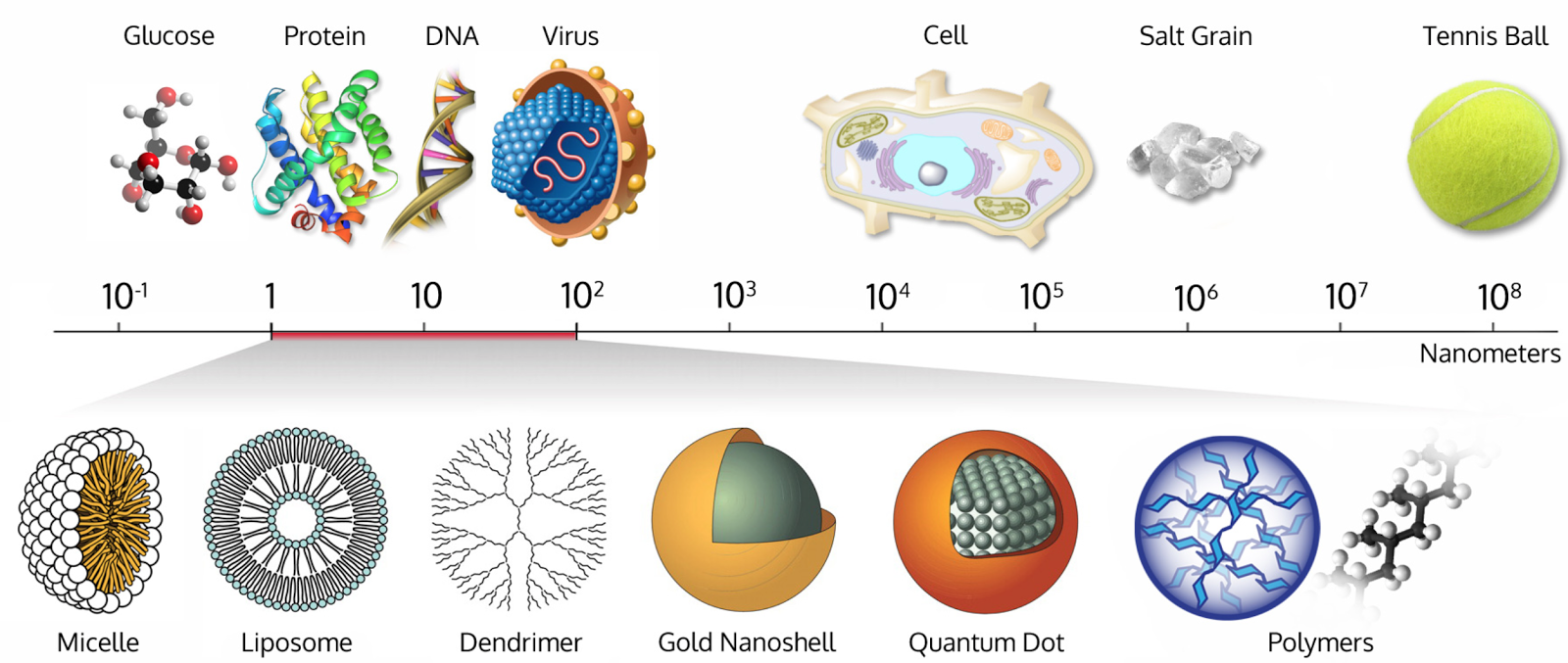
Nano-science is the study of structures on a nanoscale such as those seen in the above picture. Structures such as the Micelle,  Liposome, Gold Nanoshell, etc. are classified as nanoparticles measuring 100 nanometers or less across. According to an article published in Science News that is equivalent to a 'thousandth the thickness of a dollar bill'. Crazy small right?
Nano may indicate their size but their effect once inside the body is anything but. Scientists realised that due to their size these particles are able to penetrate deeper than any medicine on the market, opening the door to better medicines and diagnosis. 
When using nanoparticles scientists have a major decision on their hand- what one to use? Interestingly, the properties of nanoparticles vary widely from their full sized counterparts   take Gold as an example when smashed into Nano Gold Particles they become red! After the selection process is complete and you have your nanoparticle you now have to engineer them to carry out a role once inside our body. These roles can be anything! From express delivering drugs to target cells deep in our tissues or fit them with colourful or fluorescent tags that allow you to spot tumorous growths or blocked vessels. 


The possibilities are endless with nanoparticles! For this post however I am going to focus on two major medical applications for this technology. 

How do they work?


Atherosclerosis


Atherosclerosis is a common condition suffered by people with cardiovascular disease. It occurs when the bodies blood vessels (arteries, veins and capillaries) become blocked by fatty deposits on the vessel wall (in the picture below) 


Here is a fun fact 4.55 Litres of blood is pumped through your heart every minute. Take a minute to think about that, and your heart has just pumped 4.55 Litres of blood- again. Once pumped our blood is set on a circuit determined by our bodies circulatory system. In healthy people this is a very smooth journey, however, if you suffer from cardiovascular disease this smooth journey is suddenly riddled with barriers. 
These barriers are of course those fatty deposits mentioned earlier. Over time they begin to form plaques on the vessel walls, this causes the walls to become thicker and less flexible. This process triggers the release of distress signals that are answered by our bodies immune cells. However, the presence of these cells along with the cells in the blood further exacerbate the problem by forming a larger blockage  and further reducing blood flow. 
Vessel blockages have major implications for patients especially if they form in vessels leading to the brain or heart as these could lead to a stroke or a heart attack.


Treatment for this condition is mainly prescribing Statins. This medication doesn't solve the problem but it aids in the management of atherosclerosis by lowering circulating cholesterol a major contributor to the formation of plaques. However, this treatment comes with an increased risk of Diabetes and Liver damage. Nothings perfect.  

This will all change! With the help of nanoparticles. Scientists have been engineering nano missiles that will carry out search and destroy tasks for plaques! They can do these in four ways: 

1. Immune cells respond to distress signals released from blood vessels affected by plaque formations. Once there they attempt to clear the blockage by binge eating the fats gradually becoming a 'foam cell' they send signals of more immune cells to join the bingeing session. Such a build up of immune cells can be used as a biological signpost for nanoparticles to home in on target vessels. In animal studies nanoparticles prevented the  bingeing session entirely and in doing so reduced blockages by 37%.  

2. Engineering nanoparticles to masquerade as HDL. High density Lipoprotein (HDL) is the bodies 'good cholesterol'. It breaks down plaques and transports the debris to the liver where it is broken down. HDL also stops immune cells from forming 'foam cells'. 

3. Statins are not down and out for the count, in fact nanoparticles may catapult them to the front of the line for atherosclerosis treatment. Willem Mulder has designed his particles to deliver statins directly to the plaques. This approach allows for the drug to be administered at a a lower dosage but with a larger effect! 

4. Melina Kibbe has made the blood vessel wall her nanoparticles prime target. Vessels affected by atherosclerosis become damaged and stretched exposing a key structural element called collagen. Her nanoparticle has a protein capable of binding to the target (exposed collagen) attached to nitric oxide. Nitric oxide is a chemical that once in the body trigger the growth of new cells in wounded areas. However, she did not stop there she also changed her nanoparticle from the characteristic spherical shape to a nano fibre in order to increase the surface area of the particle. 

With clinical trial looking very promising nanoparticles could offer a way out of surgery for patients carrying a high risk of heart attacks or strokes as a cause of atherosclerosis. 

Cancer

Globally, the majority of deaths caused by cancer are preventable. Prevention strategies such as vaccination programmes, routine screenings make use of some of our best technology and tools but they carry a major limitation. The majority of cancers can remain undetectable for the first 10 years inside a patient at this time tumours can be some 50 million cells strong. Clearly, innovations in cancer treatment as well as cancer detection are required. Such innovations could lie in our nano sized friends. 


This incredible woman on this TED talk I watched used nanoparticles to detect the presence of tumours- this is how it works. Cancerous cells are the ultimate weapon. They are tough and stubborn because they are your cells gone haywire. Like our cells they need a good blood supply to sustain their crazy growth rates. A cancers blood vessels however, are leaky allowing a clear access point for nanoparticles.
When it comes to biology, size does matter.  A nanoparticles size largely dictates where in the body it has access to and where it does not. This nanoparticle was designed to become activated when cancer cells produce an enzyme essential for their success. In addition to this the nanoparticle was also engineered to make detection as simple as possible. When activated by the cancer enzyme the nanoparticle produces a signal that is deposited in the urine. Similar to how a pregnancy test is used, the presence or absence of this signal can be detected from a patients urine.
This nano detecting particle will be able to pick up on even the earliest stages of cancer. 

It is difficult for our bodies immune system to eliminate cancer cells because at the end of the day cancerous cells are our cells. This allows cancer to exploit the lesson taught to all of our immune cells- do not destroy our cells.  Tumours also surround themselves in their own micro-environment,  this simulates the illusion that there is nothing to worry about further throwing immune cells of their attack path. 
The authors of an amazing study featured in Nature  managed to implant a nanoparticle with tumour RNA (carries information of the tumours DNA) and injected it into animals. Once inside the body these engineered nanoparticles carried the tumour RNA to special tissue that contain large numbers of immune cells. Once there the nanoparticles activate the immune cells by simulating a viral invasion inside the body. Activation of these immune cells leads to the activation of the big daddy immune cells known as T cells. Once they have been told how to recognise the tumour cells in the body they are primed and ready to unleash their anti tumour response by eliminating it! 
This is such a promising study for the future role nanoparticles have to play in the fight against cancer.  

Well that was it guys! The blogs 100th post hope you enjoyed it and that you have a greater understanding of nano science!
Science is so amazing the phones went through a miniaturisation age I suppose it was bound to happen for science to. Of course these are in early development and whether using nano particles carries any long term effects on the human body remain unknown. For now it is comforting to say that this branch of science is extremely promising. 

Biobunch, 
Over and Out

Greetings everybody, 


I bet you are all thinking 'wow Biobunch has not done one of these Biology Behind posts for a while' and you are so right I haven't! But I got to thinking have you ever wondered why you cannot help but come back to Biobunch every Friday? I'm afraid it may be because you are addicted to the website, have no fear though! because I am going to help you understand the biology behind your Biobunch addiction. 


There are many ways of thinking of addiction however, a great scientist once broke it down into three distinct stages, with each stage exploiting certain sections of your wonderful brain anatomy in order to make you feel the way you do. 


Stage 1: The Bingeing/Intoxication stage 
Characteristics of this stage include overstimulation of our brains reward system, eventually this leads to loss of control over the thing that we are craving, and ends in bingeing. There are three parts of our brain exploited during this system. 


Basal ganglia: Involved in processing rewards and the formation of habits

Nucleus accumbens: The section of our brain that receives dopamine released from the ventral segmental area. The nucleus accumbens helps to control our satiety, inhibition and inner desires.


Ventral Tegmental Area: Otherwise known as one of our brains primitive structure, and is located near the top of our brain stem. It is also our dopamine factory, and produces all the brains dopamine (responsible for giving us that feel good feeling). 


Stage 2: Withdrawal symptoms and the 'negative moods'
Habitual exposure to the addictive substance or behaviour eventually leads to a reduction in the number of dopamine receptors present in the Nucleus accumbens. 


Nucleus accumbens: The reduction in the number of dopamine receptors present on the surface, places a demand on the brain to engage with more of the addictive behaviour or substance, just to reach a similar level of feel good feeling. 

Amygdala: Changes within this structure triggered by addiction have been twinned to the emotions and behaviour suffered by people going through withdrawal such as irritability, anxiety and stress.


Stage 3: Anticipation
People that have become dependent on a behaviour or substance carry around these uncontrollable cravings to repeat this addiction.


Frontal cortex: Circuitry thought to be messed up by drug misuse. This structure is made of two parts that play a role in addiction: The prefrontal cortex is important for thoughts and actions and the orbitofrontal cortex plays a part in controlling behaviour.

Hippocampus: This structure aids in fixing our desires whether they or not they have negative consequences. They do this through the consolidation of our memory.


The exploitation of our reward system:

As previously mentioned the Ventral Tegmental Area of the brain is responsible for the production and release of dopamine when stimulated. Dopamine is linked to the feeling of pleasure and euphoric experiences. However, the release of dopamine can be inhibited or controlled by the GABA neuron that is also present in this area. Check out the diagram of the reward system below:


Addictive substances such as alcohol, amphetamines and cocaine wreak havoc on our brain reward system by affecting the release and inhibition of dopamine by imitating neurotransmitters. Check out some of the examples listed below:


Alcohol, Opioids and Cannabis: These substances suppress the inhibitory action of the GABA neurons, allowing for unregulated release of dopamine.


Amphetamines and Nicotine: These drugs directly activate the release of dopamine into the brain.

Cocaine: This drug works by blocking the process through which dopamine is removed from synapses (a gap between two neurons), this ensures a continued state of euphoria.


The genetic link between our metabolism and addiction risk:

There are many social and psychological factors that are thought to increase the risk of some individuals to addiction, however, we are looking more at biology so I am going to bring you into the world of genetics! Yay! Some of the strongest genetic risk factors for developing an addiction such as alcoholism are those linked to our bodies metabolism.


Genes encoding for the metabolism of alcohol as seen in the above picture plays a role in the development of addiction. Acetaldehyde is toxic to the body and is quickly converted into acetate. However, the gene ALDH2 causes the toxic acetaldehyde to linger and build up in our system, this causes the onset of hangover like symptoms (nausea, temperature). The presence of this gene makes even light drinking semi- unbearable,  those individuals expressing this gene variant are nine times less likely to suffer from alcoholism, as a cause of this. Interestingly, genes encoding for slow alcohol metabolism (such as the ALDH2) are found most commonly in the Asian population. 


Interestingly, where the presence of that gene variant reduced the risk of developing an addiction it is the opposite for those predisposed to cigarette addiction. The presence of a gene called CHRNA5 more than doubles your risk of becoming addicted to nicotine. Smokers often remember their first smoke as being an un-pleasureable experience due to a heavy nauseous feeling. CHRNA5 expression in individuals was found to reduce this initial negative effect, even though the mechanism of how this happens remains unclear it may be linked to the CHRNA5 coding for a section of the acetylcholine receptor (receptor involved in pleasurable experiences) in our brains.

The long road to recovery:

OK, I know what your thinking, addiction really messes with our brain so, how can we possibly recover from that? It's most definitely an uphill battle for recovery from addiction as many of the changes are long lasting. HOWEVER! what should we always remember when it comes to our anatomy? Your body is amazing. That includes your brain, given the time a majority of the physical damage can be undone. 
Brains of people who suffered from alcohol abuse disorders often shrink, given time and sobriety the brain can regain some of its original mass.
Additionally, functional recovery also gets underway. It may not be able to restore all the damaged pathways but it begins to find alternative routes avoiding damaged parts of our brain, much like how the voice on your GPS screams out 'Rerouting' or 'Calculating alternative route' when you miss that turn on the road. AMAZING #teambrain

Alright guys, that marks the end of the post! I think what we have learned here is that you may be addicted to Biobunch but that is OK! because I think that addiction is completely healthy. In fact, I would recommend you continue your weekly dose, however feel free to increase your dose as required there are 90 posts on this blog. Have you read all of them? If so which was your favourite, be totally honest. Till then, as always have an awesome weekend.

Biobunch,
Over and out.


Back to Top