Showing posts with label Overexploitation. Show all posts
Hello to all my lovely readers

It is officially the Easter Weekend everybody, and I have a quick message to all my student readers. Use your easter holidays wisely. Most of your notes should be now completed so revise from these, and sit as many past papers as you possibly can!  Now onto today’s post. Thanks to Donald Trump and his stand on Climate Change this topic has once again been catapulted to the front of all our attention. Climate Change is a fact, but it is not the biggest threat to our planet's biodiversity.  

Over-exploitation and large-scale land use change (e.g. forest to farmland) are two of the largest threats to our biodiversity. Overexploitation is an umbrella time that covers overfishing as well as illegal wildlife trade. Sadly, there has been an increasing demand for rare animal meat and body parts, which have pushed many species closer to extinction including the Sumatran Rhinoceros, the Western Gorilla and Pangolins.

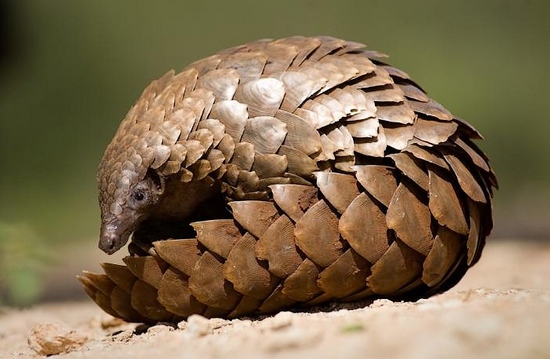
Pangolins have been practically wiped out in Vietnam, Cambodia and Lao PDR caused by relentless illegal trade. World Pangolin Day which was on February 20th succeeded in raising awareness for these scaled mammals. In fact, the King of Natural History himself, David Attenborough, deemed the Pangolin worthy of being one of ten animals he would choose to put on his own personal ark. But what is a pangolin?

Image Source

Sir David Attenborough, did not disappoint when he gifted Pangolins a ticket to board his personal Ark. Pangolins are the only mammals in the world that are covered in scales from head to toe. As a group, they are fairly small only comprising of 8 species, all of which, are found on two continents:  Africa (Black-bellied Pangolin, White-bellied Pangolin, Giant ground pangolin and the Temmicks ground Pangolin) and Asia (Indian Pangolin, Philippine Pangolin, Sundra Pangolin and the Chinese Pangolin. Image below).

Image Source

Pangolins are solitary and nocturnal animals. These scaly mammals share a dietary preference with anteaters, in that they dine exclusively on ants and termites. To help them out with their dietary choice Pangolins have extraordinarily long tongues, some of which can grow to over 40cm long. If you were lucky enough to stand in front of a Pangolin mid yawn then you would be able to see this long tongue for yourself, and that's it, as these guys are toothless! What they lack for in teeth they make up for with their stomachs. A Pangolins stomach is lined with keratinous spines to help grind up the ants and termites, they have even been spotted ingesting stones to further help this process along.

A Pangolins number one defence strategy, when faced with danger, is to roll into a ball, and if necessary lash their tails at the threat inflicting damage with those spines. Once in the safety of the ball, there is little that a predator can do to get to it as not even a big cat's canines can penetrate a Pangolins outer scales.

Sadly all eight species of Pangolins have been listed by the IUCN as either Vulnerable or Critically Endangered, and their population is constantly decreasing. 2016 was a good year for Pangolins everywhere, as CITES (Convention on International Trade in Endangered Species) successfully campaigned to transfer all 8 species of Pangolin to Appendix 1. This move has given them full protection against all international trade.

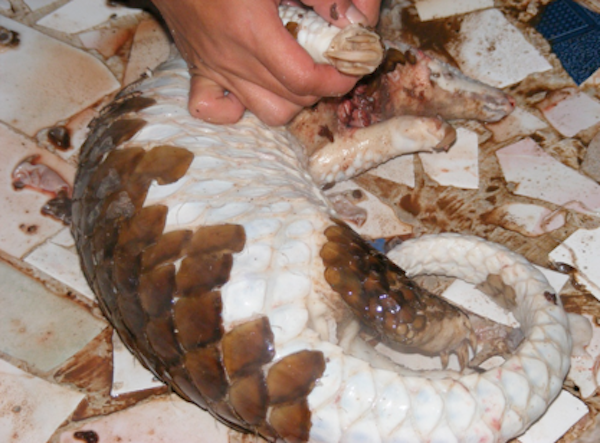
Each year, 100,000 Pangolins are captured across Africa and Asia. Despite the Pangolin becoming a protected species, they are still in demand for their scales and meat.  Cultural beliefs claim that their scales can reduce swelling and improve blood circulation. Even though it has been banned, China is still a key market for using Pangolin scales for traditional medicines (image below).


Image Source
Why are Pangolins still victims of illegal wildlife trade? Firstly Wildlife Trade is one of the most profitable businesses to be in, and the profits of pulling it off far outweigh the small consequences of getting caught. It all comes down to demand. If Pangolins have a chance we need to reduce the demand for their meat and scales. Campaigns are aiming to make it socially unacceptable to buy any products involving Pangolin sourced ingredients. A perfect example of how these campaigns can work is Tigers in Tibet,  by showing the Tigers dire situation the demand fell dramatically.

That brings us to the end of today’s post on these cute animals. I would like to think that we have all become Pangolin fans, this poor animal has suffered years of illicit trading with little awareness. The Zoological Society of London have actively engaged with the Pangolin's plight and fighting for them for more info click here. You can do this also by picking at least one fact from today's post and spreading the word.

Alright, guys, this is just a quick message before we head into the Easter Holidays. As I am a full-time tutor and this is fast becoming my busiest season I am not going to be able to keep to the usual blog schedule of every Friday! I am so super sorry for this but please be aware that during this time I am going to be stockpiling some incredible posts lined up for you, so that it is a summer you will not forget! Good luck to all student out there and I will be back here after the exam season.

Science in the City

xoxo

Greetings everybody

WWF's Living Planet Report 2016 was published last week. Media outlets have made it their mission to deliver the news of an 'impending sixth mass extinction all of our own making'. My issue with this is that it is not news. This has been a long thing coming. 
Today's post is aimed to give you a bit of perspective on this entire sixth mass extinction and more importantly WWF's Living Planet Report.


WWF's Global Living Planet Index 2016 remains to be largely unchanged since the 2014 report

WWF's Global Living Planet Index is used as a bioindicator to assess whether the world are all on course to achieve the 2020 Biodiversity targets. The Living Planet Index (LPI) is not a measurement to be taken lightly, it represents data collected on populations of over a thousand different vertebrate species and uses this number to illustrate the level of biodiversity abundance.

WWF's Living Planet Report 2014 reported a decline in LPI by 52% between the years of 1970-2010 


This Years Report showed an increase in the LPI to 58% between 1970-2012. 


Overall message: The world's vertebrate populations have declined by more than 50% in the space of just 40 years. 


The threats to our world's biodiversity hasn't changed!


In both reports from 2014- 2016 the same threats have reared their heads as the prime drivers behind our world's large-scale biodiversity loss. The image below is taken out from the 2016 Living Report.  

WWF Living Planet Report 2016 - Threat to Biodiversity

LPI's for all environments are still in a state of decline.


Terrestrial LPI:

Terrestrial vertebrate populations have reduced by 39%. Take a look at what are the main threats driving these populations to decline. 

Living Planet Report 2016 - Terrestrial LPI
For Terrestrial populations, it is clear that habitat loss and degradation is a threat shared by many. In the case of reptiles and amphibians, a combination of habitat loss alongside Invasive species and disease are causes for concern. 

Outside of the graphs and the LPI measurements WWF's report has a number of case studies from the frontline of conservation to place perspective in the land of numbers. One of the case studies focused on a population of  African elephants  located in Selous-Mikumi reserve in Tanzania. This happens to be one of the largest reserves of fauna and yet the proportion of illegally killed elephants (PIKE) is still too high to be sustainable. In 2009, the elephant population was 44,806. In  2014 it is down to 15,217. 
I know another graph but this one is nice and easy to get lots of information from! Courtesy of WWF 2016 Living Planet Report
Freshwater LPI:

Of all the vertebrate populations included in the report, those in the most amount of trouble are the freshwater vertebrates. In 2014 freshwater populations had experienced a 76% decline in numbers between 1970-2010. Recent updates on this data show that 81% of freshwater populations have been reported lost. 

Below shows the main drivers behind the large scale loss of abundance in freshwater vertebrates. 


Habitat loss and degradation appear again as a key driver behind the decline of not only terrestrial vertebrates but for vertebrates that live in freshwater as well. Overexploitation is a close running second for Birds, Mammals, Reptiles and Fish. 

Marine LPI

Vertebrate marine populations have decreased by 56% between 1970- 2010.


Overexploitation is one of the biggest threats facing marine fish, reptile, and mammal populations. Bycatch, incidental killing as well as targeted trade are all examples of overexploitation. Habitat degradation and loss playing a close second for some. 

Tropical LPI:


Tropical vertebrate populations contain some of the most charismatic and well-loved species. These are the exact same species that attract us towards many of  the best nature programs out there! int he 2014 report these species have suffered a decline by 56%.


2016 WWF Living Planet Report shines a light on ecosystems not previously mentioned before.


Check out the 2016 WWF Living Planet Report to see how Coral Reefs, Grasslands, and Rivers are affected and why the vertebrate populations residing in these areas are decreasing also. 

Lastly. The Sixth Mass Extinction is not new it has been known for a long long time! 

Just to show you guys just how much scientists have researched into this event I used the Google Scholar: 

I started off by just typing in the sixth mass extinction. In 0.04 seconds google returned with 80,700 results. The first result had been cited in other papers 1137 times!

I decided to narrow down the window.  I wanted to find out how many papers had been published in the space of 2 years from the WWF's last Living Report in 2014. In a matter of 0.05 seconds, my search gave me 12,800 results between 2014-2016 with some of them even mentioning the era of the Anthropocene.


What now?

The whole point of this post today was to emphasize just how repetitive it is all becoming. It feels a lot like it is the same story in a new format. We need to focus on what we know based on what we have: 

  • Our Biodiversity is declining at an accelerated rate
  • If this continues then the mass extinction is no longer a question of if it is a matter of when. 

These cold hard truths are uncomfortable to hear for many people and as such, they say they are dealing with it by getting scientists to gather more data to improve our statistics. This is so wrong! We have been using this strategy for years and even in the wake of better data the end message of this year's report is... crap the world's biodiversity is in trouble!  
In another two years, WWF will release another Living Planet Report, it will have the same information give or take a few percentages if we continue to sit on our buts and tweak with datasets. If we want to change the fate of our world it is relatively simple. We need to use the social media to apply pressure to the world's politics and to drive change. 

WWF Living Planet report 2014: click here
WWF Living Planet Report 2016: click here

There was a real call to action theme running through this post, but the power really is with the people! 

Biobunch, 
Over and out 

(P.S I am announcing some really cool news very very soon!)

Back to Top