Showing posts with label Malaria. Show all posts
Good morning to my lovely readers

It is the best time of week again - Friday. In fact, this will be my first weekend working as a seasonal presenter for London Zoo on Sundays, so if you are around come and find me and say hi! Today's post title may sound slightly alarming, but by the end of this post, you will understand that it is not a gross over exaggeration.

Before I introduce you to the creepy crawlies a quick crash course in terminology is required: 

Anthropophilic: The Vector shows a strong preference for taking blood meals from humans. 

Zoophilic: The vector shows a strong preference for taking their blood meals from animals. 

Endophagy: A vector that takes their blood meal indoors.

Exophagy: A vector that consumes blood from their victim outdoors.

Endophily: When the vector eventually rests they remain indoors or sheltered from the external surroundings. 

Exophily: When the vector eventually rests they remain outdoors.

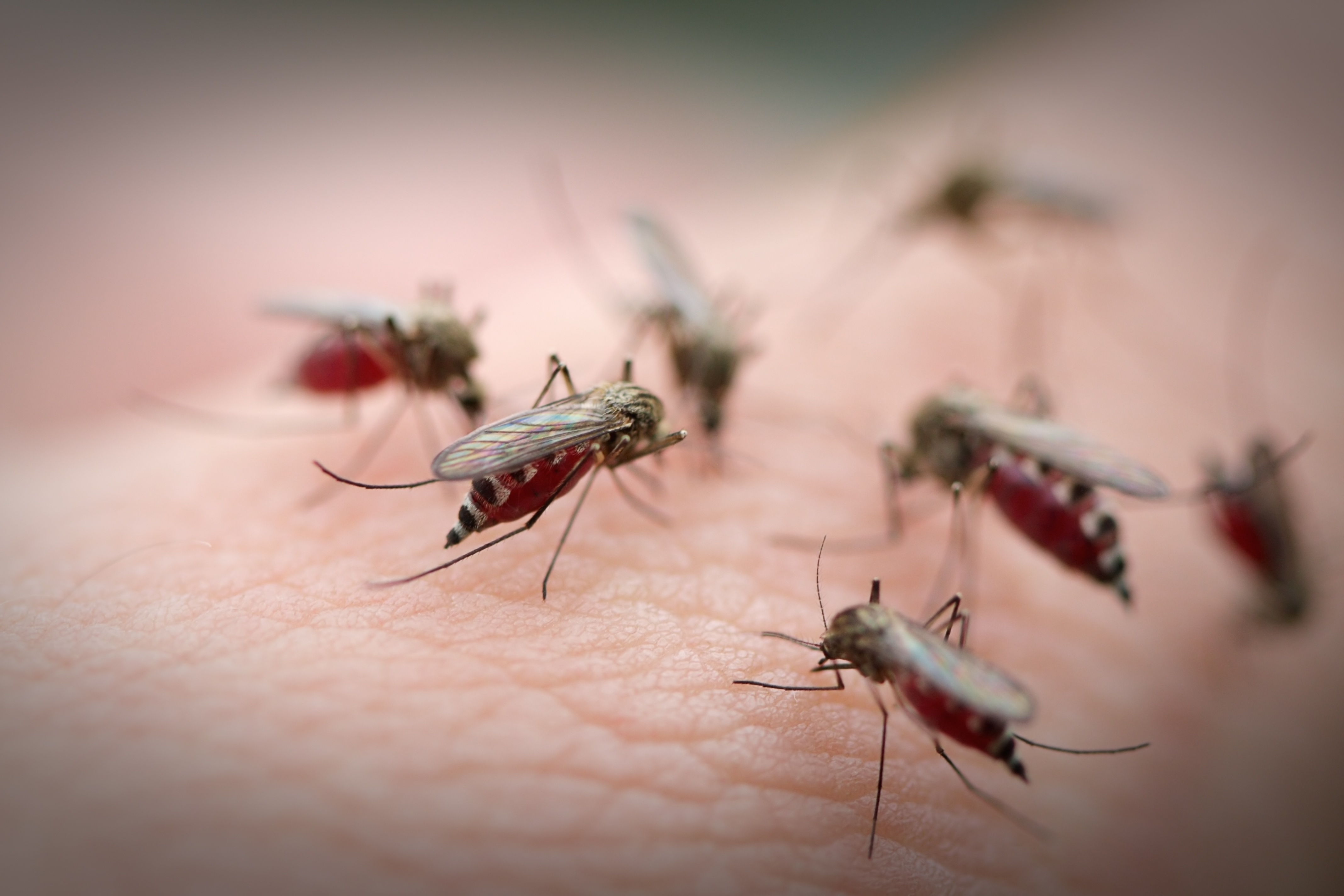
Allow me to introduce you to some of the vectors behind some of the worst diseases: 


What a great way to introduce you all to the world of vector-borne diseases. Now, these are not all the vectors known to us on Planet Earth but they are the ones that I selected for today  - make sure you keep an eye out for the next few to complete the series. 
As always everybody it was my greatest pleasure blogging for you. I am now of to learn more of my ZSL scripts for Sunday. 
Have an awesome weekend

Science in the City
xoxo
Happy Friday everybody!

Take a breather you have all survived to the end of the week, and to all those fellow UK dwellers we have all survived the winds of Hurricane Doris! It is the last Friday of February which can only mean one thing on the blog it is Friday Facts! It has been awhile I know but lets get back into it and I have gathered some awesome facts gathered from top science stories during the month of February, including one that is slightly disturbing - see if you can spot it. 

Image Source

Image Source

Image Source

Image Source

That is the end of Friday Facts all my lovely readers. Massive huge reminder to everybody! Follow me on twitter to keep up to date with any changes to the blog or any surprise posts, it is also a great way of asking me to do a post on something you would like to see featured. March 10th is a big day as the blogs website name will change more on that a little closer to the time, in the meantime have an awesome weekend...

Science in the City
xoxoxo
Hello, my lovelies!

We are fast approaching the end of the first month of January! How have those new year resolutions been going for you so far? Not great? Don't worry, everybody hits a few bumps in the road. So what you haven't done your morning exercises for a week or perhaps you haven't started learning that new language, what is a week in your entire life. You are allowed a day off, whatever you need to get back into achieving what you know you can achieve. 

'In order to succeed, we must first believe that we can.'  
- Nikos Kazantzakis

Image Source

Invasive species are costing the US economy a minimum of $42 billion in damage each year. Infectious diseases transmitted by vectors are responsible for 1 million deaths annually, many being children. Global food productivity is threatened by pests and competing plants developing resistance to insecticides and herbicides. Scientists are now casting their eyes to a possible solution that tips the laws of genetics in favour for a gene engineered by scientists. Such a technique could play a role in the conservation of endangered animals, eliminating diseases transmitted by vectors and reversing resistance to herbicides or insecticides. Gene drives hold the ability to save a species or wipe out populations. Have we gone too far?

What are gene drives?

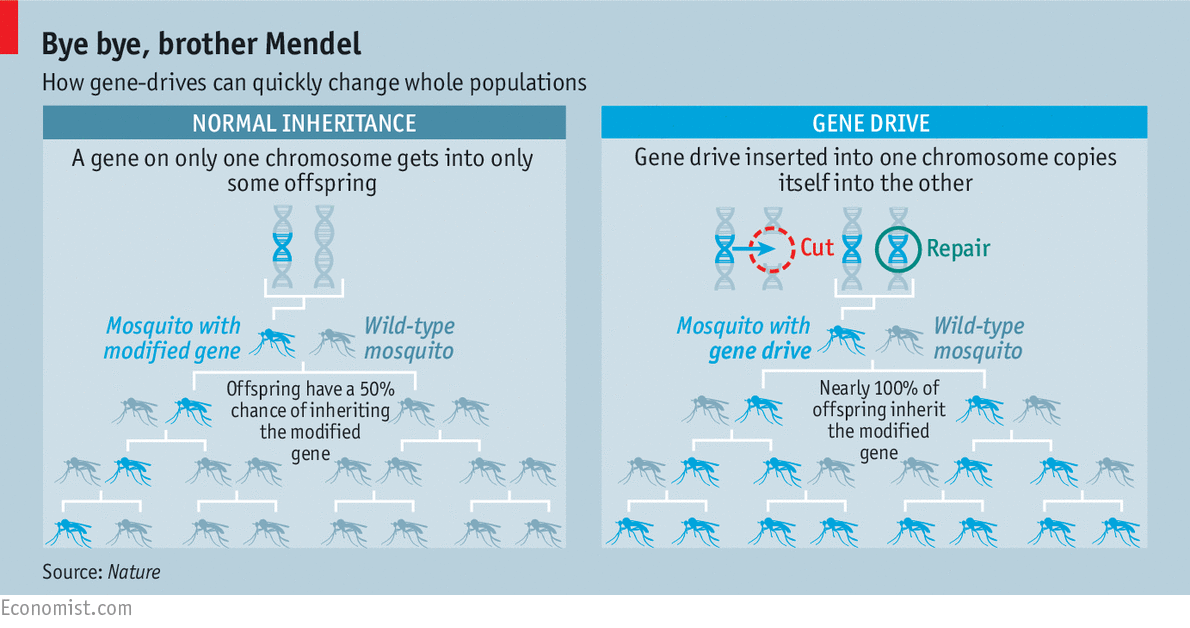
Gene drives are the next big thing in the wonderful field of Genetics. Essentially with the help of CRISPR Cas9, this genetic engineering method provides a novel way of tackling both environmental and public health issues, but how? Essentially, a gene coding for a particular trait this could be advantageous or disadvantageous (depending on whether you was to ‘save’ or ‘destroy’ a population) is introduced into an organism.

Gene drives are carried out on sexually reproducing organisms, this poses a problem to geneticists. The engineered gene drive trait has a 50/50 chance of being passed onto the offspring. Sadly this is the awkward and inconvenient truth of sexual reproduction, resulting in the engineered gene being expressed in very few individuals - the opposite to what they want to achieve. This challenge was overcome by modifying the chosen gene to act ‘selfishly’, thereby ensuring it is expressed in a larger proportion of offspring. This can be done in one of two ways.

During embryo development, one trait is chosen from either the maternal chromosome or the paternal chromosome and that is the one that is expressed e.g. brown eyes from your dad. This is avoided by the engineered trait copying itself onto both chromosomes so either way, you get the same outcome! Or, molecular biologists can ensure that the competing trait proves deleterious and results in lower viability for those inheriting it. Either way, the end product is the desirable gene increasing in frequency and spreading through the population like wildfire.

Image Source
There are two forms of gene drives seeking to achieve different outcomes: Modification and Suppression. Modification gene drives aim to ‘save’ populations by spreading desirable traits through a population. Typical gene targets for Modifying gene drives include ‘blocking pathogen development’ or ’increasing survivability’. Suppression gene drives aim to reduce/eliminate populations as such the genes targeted often provide no fitness benefit to the chosen organism including ‘reduced life spans’ and deliberately introducing a bias to ‘sex ratios’.

Potential role in Conservation:

Gene drives provide the opportunity to spread advantageous traits such as resistance to a species-specific disease. This is where engineering trumps mother nature, as the gene for disease resistance spread through the population at a faster rate compared to the long hauled process of natural selection.  

Globally, populations of amphibians are declining at an accelerated rate due to Batrachochytrium dendrobatidis otherwise known as the chytrid fungus.  How the chytrid fungus causes such high mortality remains a bit of mystery, however, it has been shown that it can disrupt an amphibian's skin. Many amphibians breathe through their skin, as such, any disruption in the epidermal layer can cause the amphibian to suffocate. Implementation of a modified gene drive may avoid future localised extinctions.

Alternatively, gene drives could aid the fight against invasive species. Invasive species have adverse effects in the areas ecology as well as the economy, this has lead people to take drastic action to mitigate against further losses.  A gene rendering a species vulnerable to a species-specific molecule (a poison or a disease) could aid in kerbing an invasive species populating growth. Such approaches are increasing in popularity due to their minimal ecological impact.

The Potential role of gene drives in disease management:

Vectors are organisms that are capable of transmitting a disease or parasite from one animal or plant to another. Common vector-borne diseases include Malaria, Chikungunya, Chagas Disease, Plague and the Zika Virus. The Anopheles genus of mosquito is perhaps one of the most famous vectors, responsible for the transmission of Malaria, Dengue Fever and Zika virus.
There have been small successes in the production of genetically engineered dengue-resistant mosquitoes, however, these mosquitoes were later found to be resistant to one subtype of dengue fever. Nonetheless, tests remain promising.   Scientists are focusing their efforts on the Anopheles that is responsible for transmitting Malaria. Malaria claims the lives of 650,000 people each year, so the need for a solution is high.
Geneticists begin by looking for a target of which to base the gene drive on, in the case of combating infectious diseases the aim is to reduce the transmission rates. Two genes instantly drew attention including the AKT transgene found in the midgut of the mosquito and the single chain antibody located in the salivary glands. The reason why these genes are receiving all the attention becomes clear when looking at the life cycle of Plasmodium (the microorganism responsible for the onset of Malaria), the image below shows the life cycle.
Image Source

The midgut of the Anopheles mosquito provides the optimal conditions for the Plasmodium gamete to become an oocyst. Once the oocyst has been formed it bursts, releasing loads of sporozoites that migrate from the midgut straight to the salivary glands so that they are successfully passed on with the Mosquito's next blood meal. The aforementioned genes play a vital role in providing an opportunity to block pathogen development or block the Mosquitoes ability to become a vector.
Limitations of gene drives:
Firstly, gene drives require the genetically engineered organisms to have many generations in order to spread through the population. Therefore, the time lapse between release and successful spread through a population depends on multiple factors of the vectors biology such as the time needed for each generation, the impact of the gene drive on individual fitness and their mating system dynamics.
When manufacturing a harmful trait to be used for a gene drive, it must be made deadly but not too deadly… Anything too deadly will result in the engineered organism dying well before they manage to pass on the trait to their offspring.
Evolution is working against you...  Gene drives work on the basis of introducing harmful traits and ensuring that they spread through a population like a wildfire. However, evolution by natural selection works on the basis of favouring individuals with advantageous traits and dooming the individuals with deleterious ones. Therefore, it is very likely that through the duration of the gene drive natural selection will lead to one organism acquiring resistance to the harmful trait and thus will be favoured, making the efforts of the gene drive obsolete.
Overall, this is an exciting field of genetics whether it be for agriculture, conservation, or for health purposes. With the development of CRISPR Cas9, it is plausible that further research into Gene Drives may well lead to them becoming a viable option in future. Is this a step too far? Or a natural progression to a solution for a long-standing problem?

Science in the City
xoxo
Greetings everybody!

Congratulations you have got through the week and it is now officially Friday! To all those students out there who have started your exam season good luck! I am sure you guys heard all about the edexcel biology question asking you to explain the link between sickle cell and malaria. May be a bit to late, but lets get it all out in the open!

Sickle Cell Disease is a heritable disease that affects the blood. Sufferers of this disease experience a symptom known as crises, a period of acute pain that varies in longevity from a few hours to days. Sickle Cell Disease is also twinned to the onset of other conditions such as anaemia, leg ulcers, jaundice, kidney damage, high blood pressures along with increased susceptibility to infections and stroke. In 2010 302,800 children were born with this crippling disease, two thirds of these children residing in Africa. By 2050, this number is predicted to rise by 25%.  Sickle cell is a growing problem in a region that is poorly prepared to deal with the increased burden on their health services.


Development of this disease all comes down to whether or not an individual inherits a gene that has a minor genetic change, otherwise known as a mutation. The mutation itself is tiny, a substitution of one amino acid for another on the gene that codes for the haemoglobin protein. How does something so small have such a large impact? Lets use the analogy of building a house. Before your house is built you have a blueprint, this blueprint details every dimension of your dream house (your DNA strand). You do not pick up on it but within that blueprint one of the measurements have been taken very wrong (the switch of glutamic acid with valine). When your dream house is completed it has a completely different shape to what you wanted (sickle shaped blood cells).

Lets get into the details of this disease. The mutation in the haemoglobin gene results in the shape of our red blood cells to change from a flexible disc shape to a rigid sickle appearance. Unlike healthy haemoglobin, 'sickled' haemoglobin binds to oxygen once and when released, sickled haemoglobin bind to one another forming rigid rods. These rigid rods then reshape the disc shaped red blood cell into a narrow crescent.


Changing the shape of red blood cells is not where it stops. Sickle blood cells also become very sticky! This increased stickiness allow them to stick to one another and form blockages in narrow blood vessels. These blockages starve tissues and organs of much needed oxygen. Additional complications such as those previously mentioned are thought to be caused by alterations of our bodies pain receptors to enhance the discomfort as well as shorter life spans for our red blood cells.

Exploring that malaria and sickle cell link


Sickle cell disease cases are typically found in areas with hot climates such as Africa. Interestingly this is where the vector for Malaria transmission is also found- the Anopheles Mosquito. Evidence suggests that such geographic concentrations of sickle cell cases may have arisen from a preference for the sickle cell trait. 
Sickle cell is a recessive disease, therefore you would need two sickle traits in order to have the disease. However, those who inherit only one sickle trait are technically carriers - those with the trait but remain healthy. Have a look below at the image showing the rules of inheritance for this disease.


Carriers are practically malaria resistant. Plasmodium (malaria causing parasite) is transferred from an infected Anopheles mosquito and once in our bodies hijacks a ride in our red blood cells, during the trip they feed of our cells haemoglobin. One theory on how carriers confer malarial resistance could be down to small changes in their blood, such as slightly higher carbon monoxide levels or possibly how the oxygen interacts with sickle haemoglobin. This combination diminishes carriers as suitable hosts for the malaria parasite. Such resistance may be selected for by women or men who will pass this resistance onto their children. 


Treatment:


Symptom based approach:


Medications such as penicillin and folic acid can treat the infection and stimulate the production of red blood cells in young children. The main drug on the market is hydroxycarbamide, it reduces the frequency and severity of crises.

Development of treatment has been slow for this disease based on lack of pharmaceutical investments. In 2010, Don Abraham a chemist at the Virginia Commonwealth University focused his efforts on synthesising a drug with anti sickle effects. Interestingly, he found a promising compound in food products that offered a gateway into preventing the sickiling of cells in caramel, roasted coffee beans and dark beer!

Isolation of specific compounds within these anti sickling food agents led to the development of Aes-103. In early clinical trial stages, it was found those on the trial drug experienced a significant reduction in pain.

Additional drug developments are focusing on making sickled red blood cells less sticky. On further examination it was found that sickled cells caused white blood cells, platelets and cells on the lining of the blood vessel to stick to one another. Such blockages are diagnosed as vaso-occlusive crises. Pain originating from such blockages can lead to hospitalisation and permeant organ damage.

Two approaches are taken to reduce these from of crises. One, synthesise a drug that will bind to the surface of sickle blood cells preventing them from blocking narrow blood vessels. Or, target a specific group of proteins that we know when activated cause cells on the blood vessel to bind to white blood cells. This group of proteins are known as selectins, and such a drug to ensure they remain unactivated was under trial in 2014, called Rivipansel. Clinical trials of this drug reduced the time spent in hospitals, the longevity of crises events and decreased the need for Opoid medication by 83%.


Tackling the gene responsible:

Such approaches are centred around the term 'gene therapy' or genetic manipulation. It involves the insertion of a functional gene in to the patients DNA, or, by editing the faulty gene within the patient. Such methods have the highest success rates in disorders resulting from a single gene mutation- like Sickle Cell. Two approaches can be taken.


First of, the conventional gene therapy this process involves healthy gene insertion. It all starts by modifying a harmful virus to insert the healthy gene into the patient own cells, these modified cells are then transplanted back into the patient. Alternatively, gene editing cal be used. In simple terms this is the equivalent of a 'cut and paste' on a molecular scale. This fixes the problem by correcting the mistake found in a specific set of stem cells known as haemotopoietic stem cells. This guys give rise to the two type of blood cell.


Alright guys,
Thats all for this week.
Biobunch,
Over and out.
Greetings everybody, 

It is the end of the week finally! Not sure if you guys saw my tweet a couple of days ago, but I have enrolled myself on to a free online course introducing Cancer Immunotherapy. Ever since the beginning of this course, my passion for immunology has been booted up again, I mean our immune system is crazy awesome! So, I decided to dedicate an entire Friday Facts post on Immunology, so enjoy it guys. 


Wasn't it awesome! have you learnt something new about your immune system, or therapeutic treatment? How about those DNA patents hey how do you feel about this? If you find this extremely interesting TEDx have an amazing video on DNA patenting and it is all about the BRCA1 gene. Totally recommended! 

Guys as always have an amazing weekend, whether you are going for an awesome let your hair down, put you heels on kind of night or are preparing for the ultimate relaxer weekend, have an amazing time! 

Biobunch, 
Over and out
Back to Top